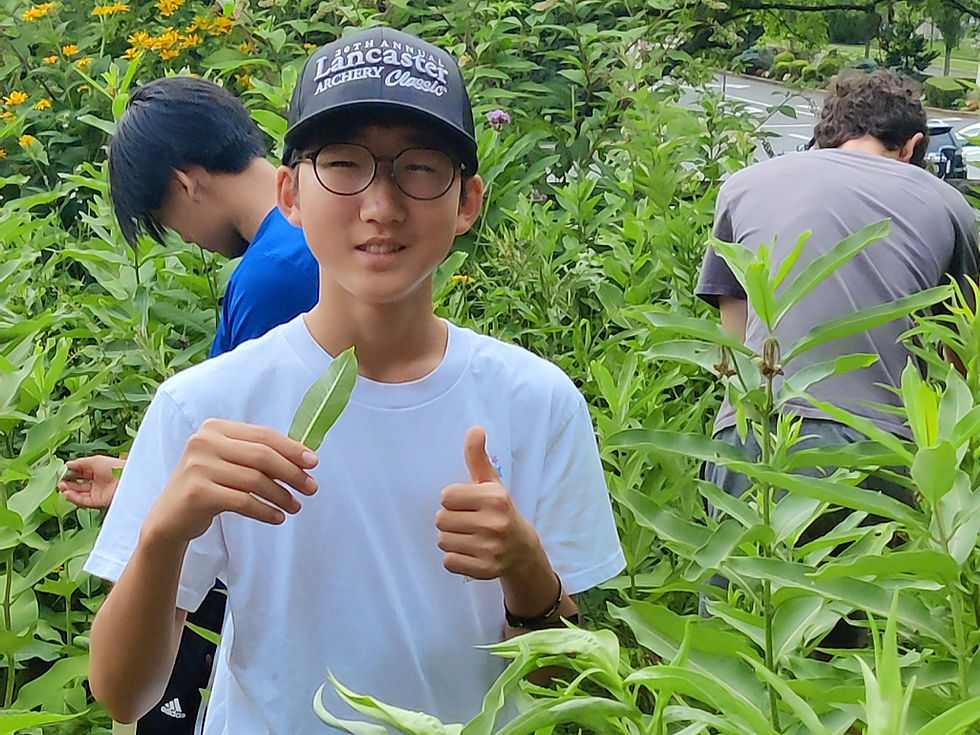
Caterpillars Connecting Communities: Skylar's Reflection
By Skylar Lee, RTR Reflection Runner-up & Syosset High School Freshman
Compelling is how I would describe my experience in the Raise, Tag, and Release (RTR) program. At first glance, I thought this program would be interesting, but somewhat mundane (no offense to Cynthia or the program itself). To my surprise, the program was very different from just raising monarchs and admiring them, like in elementary school. Without realizing it, the learning experience surrounding raising these pollinators completely transformed. Before signing up for this program, I had no idea how few monarchs there are now in comparison to back then. After learning about the survival rates of monarchs, my perspective on these little yet mighty pollinators changed.

During one of the Saturday Rewild Zoom meetings, Cynthia gave a presentation about the RTR program. The group learned monarchs currently labeled as "vulnerable" have a survival rate of 2-10% in the wild. Much lower than I would’ve guessed. Hearing this definitely put me at ease after two out of my three caterpillars had died. These caterpillars that died didn’t die from any obvious cause; instead, they just randomly shriveled up and died. At first, I was confused about why this happened, even though I followed the directions given to the group. Many of the other people in the group had a similar experience to mine, while others had no issues raising their monarchs. I was a bit unhappy, but this experience made it clear why the monarch population has a difficult time staying up. This made me realize we can do simple actions, for instance, planting milkweed for monarchs to lay their eggs on, to help monarchs have a better chance of surviving.

This program also made me see the way every little factor in an environment has its own effect. For example, without milkweed, monarchs wouldn’t be able to reproduce, causing a decrease in the population. A decrease in the monarch population would cause less pollination, an imbalance in the ecosystem as a whole, and so on. After becoming more engrossed in learning about monarchs, I felt driven to do a little bit of my own research. From researching, I found out that the migrations of monarchs are also significant, but in a different way. The occurrence of large numbers of monarchs migrating is linked to beliefs and traditions in some cultures. For example, in Mexican culture, monarchs often symbolize the return of the souls of ancestors and past loved ones. And, for the rest of the world, monarchs can symbolize diversity.
While participating in this program, I began to understand that monarchs are crucial to more than just the environment. These little insects connect people within a community, or even people around the world. Not only was I able to learn this, I was able to see it with my very own two eyes as people from different communities came together in this program with a similar care for the environment. I hope that my experience with this program may even lead me to pursue other volunteer work or internships where I can connect with more people of similar interests.
Stay tuned for more RTR Student Reflections on the Monarch Moments blog!